Measuring pipework under NRM2: from a piping MTO to work section 38
Short answer: under NRM2 work section 38, pipework is measured in metres, described by material, finish, nominal diameter, method of jointing and fixings, and generally inclusive of fittings. Where the information is available, fittings should be measured separately and enumerated instead. Valves are enumerated as pipe ancillaries, insulation to pipework is measured in metres, and supports and brackets are included in the items rather than measured. A piping MTO with pipe in metres by line and size and fittings and valves in each is the quantity a QS measures from; the description comes from the specification.
What NRM2 is, and which edition applies
NRM2, Detailed measurement for building works, is the RICS set of rules for measuring and describing building work in a bill of quantities. RICS defines a bill as a list of the items that make up the component parts of a building, with identifying descriptions and quantities, so that contractors can prepare tenders. NRM2 formally replaced SMM7 on 1 July 2013. The edition used here is the 2nd edition (UK), published in October 2021 and effective from 1 December 2021.
NRM2 is written for building works. Pipework in building services sits in work section 38, Mechanical services, which also covers equipment, ductwork, insulation, identification, testing and commissioning. This guide covers the pipework items only.
How work section 38 measures pipework
Items are set out with a unit and up to three levels of description. Three items carry most of a piping take-off:
- Pipework (item 3), in metres. Described by material, finish, nominal diameter, method of jointing, fixings and background for fixing, and then by location: roofs, high or low level in plantrooms, risers or service ducts, high or low level on floors, or in trenches. The notes say pipework is generally measured “inclusive of all fittings”, and list them: unions, connectors, flanges, bends, tees, junctions, reducers, test points, bosses, sockets and tappings.
- Pipe fittings (item 4, an alternative), enumerated. The same fittings counted as items of their own, described by type, material, finish, nominal diameter and method of jointing. It is used when the fittings are measured separately instead of being included in the pipework.
- Pipe ancillaries (item 5), enumerated. Valves, strainers, expansion bellows, anchors, guides and rollers, traps, pipe sleeves and similar, with the same description fields as fittings.
The general rules apply on top: work is measured net as fixed in position, and quantities are given to the nearest whole number, with anything under one unit given as one. A model length to a decimal place therefore becomes whole metres on the bill. Section 38 lists all waste among the works and materials included in its items, so waste is covered by the item rather than measured as one of its own, and a net length from the model is the right starting point.
Fittings: inclusive, or measured separately
The section’s own notes settle the choice. Where the information is available, pipework should be fully detailed, with the fittings identified and measured separately under the alternative item. Where it is not, pipework, and the insulation and fire protection that go with it, are measured inclusive of fittings.
When the fittings cannot be counted from the information to hand, the inclusive route keeps the bill possible. A model changes that: if it publishes its fittings as objects, the count by type and size is information that is available, and the separate measurement the notes prefer becomes practical. Counting them well is its own job; see how to count pipe fittings and valves in a Navisworks model.
What an NRM2 pipework bill needs vs what a model MTO gives
A line-based MTO supplies the quantities and part of the description. The rest of the description comes from the specification and the drawings, as section 38 expects: its list of information to provide starts with the type, quality and size of materials, the method of fixing and the location.
| Section 38 item | Unit | A model MTO gives | From the spec or drawings |
|---|---|---|---|
| Pipework (item 3) | m | Metres by line and nominal size; material where the model publishes it | Finish, method of jointing, fixings, background for fixing, location |
| Pipe fittings (item 4, alternative) | nr | Each, by line, type and size; two sizes on reducing items | Finish and method of jointing where the model does not carry them |
| Valves and other pipe ancillaries (item 5) | nr | Valves each, by line and size, with the type where the model publishes it | Ancillaries that were never modelled as objects; finish and jointing |
| Insulation to pipework (item 9) | m | The pipe metres by size that insulated lines are measured on | Which lines are insulated, thickness, material and finish |
| Supports and brackets | included | Nothing to measure: they sit inside the pipework items | The support design, if you want your own count for pricing |
The fields a model rarely fills are the method of jointing and the fixings, and both change the rate. Read them from the specification once per system, and write them into the bill description, not into the take-off.
Supports, brackets and insulation
Section 38 lists all couplings, brackets, supports, fixings and cast-in channels among the works and materials included. They are not measured as items of their own, so the rate for each metre of pipework has to carry them. If you price supports from your own count, that count is a pricing aid, not a bill quantity. Anchors, guides and rollers are the exception the section names: they are listed with the pipe ancillaries and enumerated.
Insulation to pipework is measured in metres, stating thickness, material, finish and the nominal diameter of the pipe, and generally inclusive of fittings. Insulation to fittings can instead be enumerated under its own alternative item, and insulation to pipe ancillaries such as valves is enumerated. Take the pipe metres by size from the MTO, and the insulated systems, thicknesses and finishes from the specification.
From MTO rows to bill items
The rows of a line-based MTO already hold the quantity and the size. Building the bill from them is a grouping exercise:
- Group pipe rows by what changes the description. Material, nominal size and, from the specification, jointing and fixing. Each distinct combination is a pipework item in metres.
- Split by location where the rules ask for it. Rows broken down by line or system make it easier to put plantroom, riser and floor-level runs into separate items, with the drawings deciding high or low level.
- Decide inclusive or separate fittings once. If the fittings are measured separately, each fitting row becomes an enumerated item by type, material and size. If not, keep the fitting counts as a check on the pipework rate.
- Enumerate the valves. Valve rows become pipe ancillary items by type and size; add strainers, traps and other ancillaries from the schedules where the model does not hold them.
- Round last. Total the metres per item, then round to whole metres, so rounding is applied once per item and not once per row.
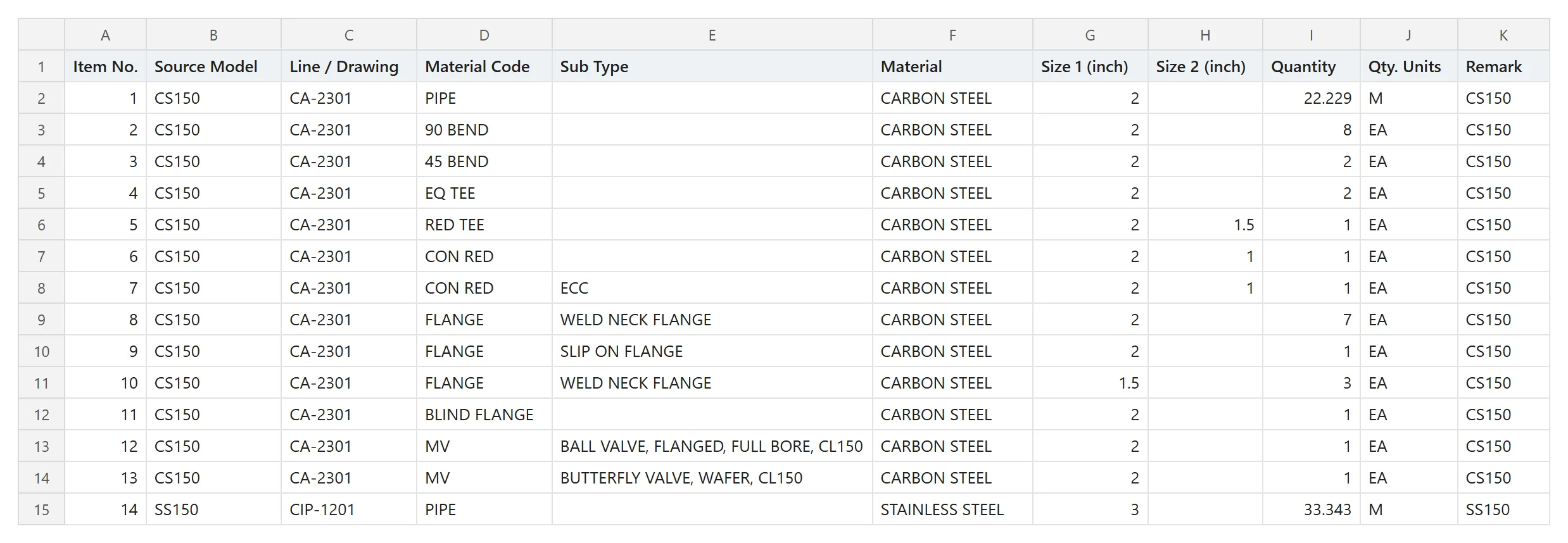
The columns are explained in the piping MTO Excel template, and the difference between an MTO and a bill of quantities is set out in the piping take-off glossary.
Worked example: what the sample row can and cannot supply
Download the sample Excel workbook and open the MTO sheet shown above. Its quantities are synthetic. They illustrate how to inspect an MTO before preparing a bill; the sample is not an NRM2 bill and carries no project specification from which to complete one.
| Source row | Available in the workbook | Decision needed for the bill |
|---|---|---|
| MTO, row 2 | CA-2301; carbon-steel PIPE; 2 inch; 22.229 m | Confirm the specification, finish, jointing, fixing and location before grouping the metres into a pipework item |
| MTO, row 3 | The same line and material; 2-inch 90 BEND; 8 each | Confirm the fitting description and whether the bill measures it separately or includes it in pipework |
| MTO, row 13 | The same line and material; 2-inch flanged full-bore ball valve, CL150; 1 each | Check the valve schedule and complete the ancillary description |
The workbook does not identify the location or insulation requirement of that pipe row. Do not fill those gaps from the line name. Keep 22.229 m as the source quantity, combine only rows that belong to the same described bill item, and then apply the bill’s rounding rule to the grouped quantity. Counting the eight bends separately also requires the pipework item and its rate to use the same measurement basis.
The sample PDF report gives the scope totals and size breakdown for comparison. It helps check the quantities carried over; it does not supply the missing bill descriptions. Once the description and measurement basis are settled, the estimating-tool mapping guide shows how to preserve quantities and units when you transfer them for pricing.
Where Metriq MTO fits, and where it stops
Metriq MTO turns a Navisworks NWD into a line-based piping MTO in Excel: pipe in metres by line and size, fittings and valves in each, and a PDF report you can send with the bid. Every quantity comes from objects published in the model, and anything the model cannot evidence is listed rather than counted. That is the input a QS measures from.
It does not produce an NRM2 bill of quantities. The descriptions, the inclusive or separate decision, location, insulation and the rounding stay with the person preparing the bill. See a finished workbook in the sample take-off, or read the wider guide to a piping MTO from Navisworks.
Questions estimators ask
Does NRM2 measure pipe fittings separately?
It allows both. Work section 38 measures pipework in metres, generally inclusive of all fittings, unless the fittings are measured separately under the alternative item for pipe fittings, where each is enumerated by type, material, finish, nominal diameter and method of jointing. The section’s notes ask for fittings to be identified and measured separately where the information is available, and for pipework to be measured inclusive of fittings where it is not.
Are pipe supports measured under NRM2?
Not as items of their own in work section 38. Couplings, brackets, supports, fixings and cast-in channels are listed among the works and materials included, so they are priced within the measured items. Anchors, guides and rollers are named among the pipe ancillaries, which are enumerated.
How is pipe insulation measured under NRM2?
In metres, with the thickness, material, finish and the nominal diameter of the pipe stated, and generally inclusive of fittings. Insulation to pipe fittings can instead be enumerated under its own alternative item, and insulation to pipe ancillaries such as valves is enumerated too.
Which edition of NRM2 does this guide use?
The 2nd edition (UK) of NRM2, Detailed measurement for building works, published by the Royal Institution of Chartered Surveyors in October 2021 and effective from 1 December 2021. Check rics.org for any later reissue before you rely on a rule.
Can Metriq MTO produce an NRM2 bill of quantities?
No. Metriq MTO produces a line-based piping MTO in Excel, with pipe in metres by line and size and fittings and valves in each, plus a PDF report. Turning those quantities into described NRM2 bill items, with jointing, fixing, location and insulation, is the quantity surveyor’s work.
Sources
- NRM2: Detailed measurement for building works, 2nd edition UK (work section 38; general rules 3.2) (RICS)
- NRM2: Detailed measurement for building works (Designing Buildings Wiki)
Links checked in October 2026. Menu names and pages can move between releases.
A line-based piping MTO in Excel, with exact copies counted once and anything the model cannot evidence listed.